
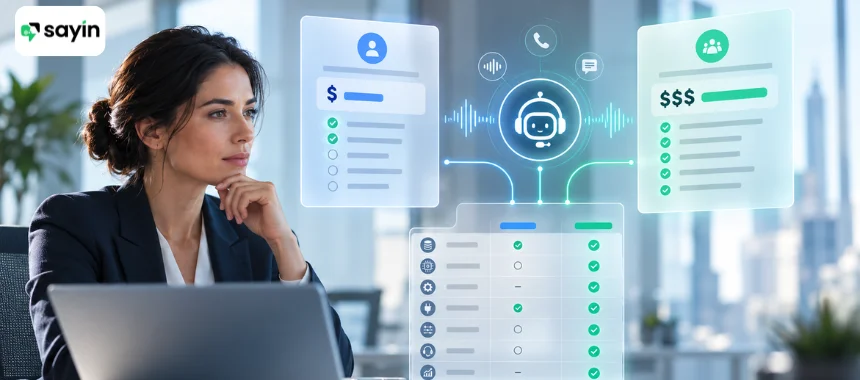
Evaluating quotes for an AI voice agent presents a distinct challenge. For example, two proposals for the same project often display wildly different numbers because providers package their billing units and underlying technologies in different ways.
However, an advertised $0.05 per minute rate, $0.14 per minute rate, a $500 monthly subscription, and a custom enterprise proposal do not represent equivalent scopes of delivery. One figure might cover bare platform runtime, while another includes full speech processing and ongoing conversation tuning.
As a result, comparing these numbers directly creates serious budgeting errors. AI voice agent pricing is only comparable when buyers normalize what is included in the offer before comparing the rate. This guide details how vendors structure their pricing, what components hide inside or outside a quote, and how to build a normalized financial baseline before signing a contract.
How Much Does an AI Voice Agent Cost?
There is no single category-wide rate for AI voice agents. Because providers scope and bundle capabilities differently, pricing models vary across the market.
Commercial structures typically align with one of these models:
Before Comparing AI Voice Agent Prices, Normalize the Quote
Therefore, procurement and operations teams should analyze every offer across five core dimensions before comparing headline prices.
1. What is the billing unit?
Vendors measure consumption differently. Common units include connected call minutes, billable engine seconds, usage credits, monthly base allowances, or fixed concurrency tiers. A vendor charging $0.08 per credit may end up costlier than one charging $0.12 per minute if a single minute consumes multiple credits during active dialogue.
2. What technology is included?
A complete voice AI interaction requires speech-to-text (STT), large language model (LLM) reasoning, text-to-speech (TTS) synthesis, telephony transport, and platform orchestration. A quote may bundle all of these into a single rate, pass component costs through at variable vendor rates, or require buyers to supply their own API keys for model runtime and carrier SIP trunks.
3. What operational work is included?
Deploying an enterprise agent requires workflow design, tool integration, prompt engineering, edge-case testing, and continuous latency optimization. Self-service platforms leave this engineering workload to internal teams. Managed providers include initial build-out and ongoing performance tuning in the commercial agreement.
4. What remains variable?
Identify all cost triggers that scale with volume. Calculate overage penalties, charges for exceeding concurrent call limits, premium routing fees for international telephony, and added fees for advanced analytics or specialized LLM fallback models.
5. What commercial constraints apply?
Look closely at contract terms. Annual minimum spending requirements, monthly floor limits, and several other factors shift total expenditure.
What Can Be Included in an AI Voice Agent Quote?
Understanding why quotes vary requires breaking down the core operational components that go into deploying and maintaining a production-ready voice agent.
Depending on the vendor, these items may be exposed as separate line items or bundled together into a unified service:
- Technology and Usage: Call runtime engines, real-time speech processing, generative model inference, and inbound/outbound telephony.
- Deployment and Engineering: Conversation flow architecture, custom webhook/API integration into CRMs or CCaaS platforms, system testing, and go-live launch support.
- Ongoing Operations: Live conversation monitoring, prompt refinement, intent drift correction, platform maintenance, and dedicated account support.
When evaluating self-service platforms, remember that excluded engineering items do not vanish; they shift to internal developers.
How AI Voice Agent Pricing Is Commonly Structured?
Rather than sticking to rigid pricing models, providers routinely blend different commercial structures to meet enterprise requirements.
- Usage-based Pricing: Buyers pay strictly for consumption, calculated per second or per minute of connected call time. While this model offers zero-commitment flexibility for variable volumes, unpredicted call spikes can cause monthly budget swings if overage controls are not configured.
- Subscription + Included Usage: The vendor sets a fixed monthly fee that covers platform access alongside a predetermined volume of usage (e.g., 2,000 minutes per month). Consumption beyond the quota incurs a designated per-minute or per-credit overage charge.
- Platform or Component-based Pricing: The vendor separates platform access from underlying infrastructure costs. Buyers pay a fixed monthly subscription for the orchestration layer, then pay separate usage fees or pass-through API rates for telephony, STT, LLM inference, and TTS generation.
- Managed or Enterprise Pricing: Designed for complex operational requirements, these custom contracts bundle technology, end-to-end implementation, ongoing conversational tuning, dedicated concurrency limits, and enterprise SLAs into a single commercial agreement.
How to Compare Two AI Voice Agent Quotes?
To evaluate competing offers effectively, procurement teams should follow a four-step normalization method to establish an equal baseline.
Step 1: Set a Fixed Usage Baseline
Select a representative operational baseline for evaluations, rather than relying on arbitrary vendor billing metrics.
Step 2: Separate Recurring from One-time Charges
Isolate non-recurring implementation costs (custom integration, initial workflow building) from fixed monthly subscriptions, variable runtime charges, carrier fees, and recurring support contracts.
Step 3: Map Exclusions Across Both Quotes
Identify where one proposal covers operational scope that the other leaves out. If Quote A excludes telephony or prompt optimization, calculate the internal engineering hours or external vendor rates required to bridge the gap.
Step 4: Calculate Normalized Recurring Monthly Spend
Reconcile all values using this procurement comparison matrix:
Using this method shifts the conversation from the headline rate to the normalized recurring cost, helping teams make informed financial decisions.
Illustrative Example: Comparing Two Quotes at 10,000 Monthly Minutes
To see this framework in action, consider a hypothetical contact center evaluating two proposals for 10,000 monthly connected minutes.
- Quote A (Self-Service Platform): Displays an attractive headline rate of $0.05/minute. However, contract terms reveal a $200/month platform access fee, pass-through telephony at $0.015/minute, model fees averaging $0.025/minute, and no included operational support or integration assistance.
- Quote B (Managed Service Package): Displays a higher upfront cost with a $500/month subscription that includes 2,000 minutes, setup, inbound/outbound engine access, and ongoing conversation tuning, with additional usage billed at $0.09/minute.
Key Takeaway: Quote A’s $0.05 headline rate yields an effective cost of $0.11 per minute ($1,100 total) once infrastructure components are accounted for—before factoring in internal developer time. Scope normalization reveals the true financial proximity of the two options.
Questions to Ask Before You Sign an AI Voice Agent Contract
Before signing a commercial agreement, present these seven operational questions to prospective vendors:
- What exactly counts as billable usage?
Does billing trigger on answer, ring-back, or media connection? Are silent periods, transfers, IVR navigation time, or failed call attempts billed at full rate?
- Which technology and telephony costs are included?
Does the rate include complete speech processing, model reasoning, and carrier charges, or will our finance department receive separate pass-through API invoices?
- What fixed monthly fees apply?
Are there recurring platform access charges, base subscription costs, or seat licenses that apply regardless of our actual call volume?
- What setup, integration, testing, or launch work is included?
Does the agreement cover custom CRM webhook development, prompt architecture, latency testing, and initial rollout support, or is that scoped separately under a professional services SOW?
- What happens when usage exceeds the allowed limit?
How are overages calculated? Are overage minutes billed at the standard rate, or do tier penalties apply when quotas are breached?
- What ongoing monitoring, tuning, and support are included?
Who monitors conversation transcripts for intent drift, false escalations, and prompt hallucinations post-launch? Is continuous model tuning included in our plan?
- What minimum commitments or enterprise constraints apply?
Are there mandatory annual volume floors, maximum concurrent call limits, paid enterprise SLA tiers, or extra compliance charges for SOC 2 or HIPAA validation?
Applying the Pricing Framework to Sayin
Sayin provides a managed AI voice agent platform designed to eliminate complex multi-vendor management and engineering overhead.
Rather than requiring buyers to stitch together separate platform, model, and telephony agreements, Sayin publishes a clear commercial structure:
- Standard Plan: $500 per month, which includes 2,000 connected minutes, complete inbound and outbound call handling, system setup, custom workflow configuration, and the first four weeks of dedicated conversation tuning.
- Enterprise Plan: Tailored commercial packaging available for operations requiring custom concurrency reservations, dedicated infrastructure, and advanced SLAs.
Summary
AI voice agent pricing offers meaningful transparency only when quotes reflect equivalent operational scope. However, before accepting the lowest advertised rate on a proposal, systematically normalize the billing units, technical components, setup effort, variable overages, and commercial constraints across every offer. Reconciling these five variables allows enterprise buyers to evaluate actual recurring costs accurately and select the right partner for long-term operational performance.
View Sayin pricing plans to evaluate our standard package and enterprise options.
Stop Overpaying for Unbundled Voice AI Infrastructure
Comparing unbundled platform fees and internal engineering costs shouldn’t feel like solving a puzzle. Sayin gives you a fully managed, production-ready AI voice agent platform with clear monthly pricing.
- Predictable Commercial Terms: $500/month Standard plan with 2,000 connected minutes, onboarding, and the first four weeks of tuning included.
- Enterprise-grade Scaling: Reserved concurrency, dedicated SLAs, and custom compliance frameworks available.