
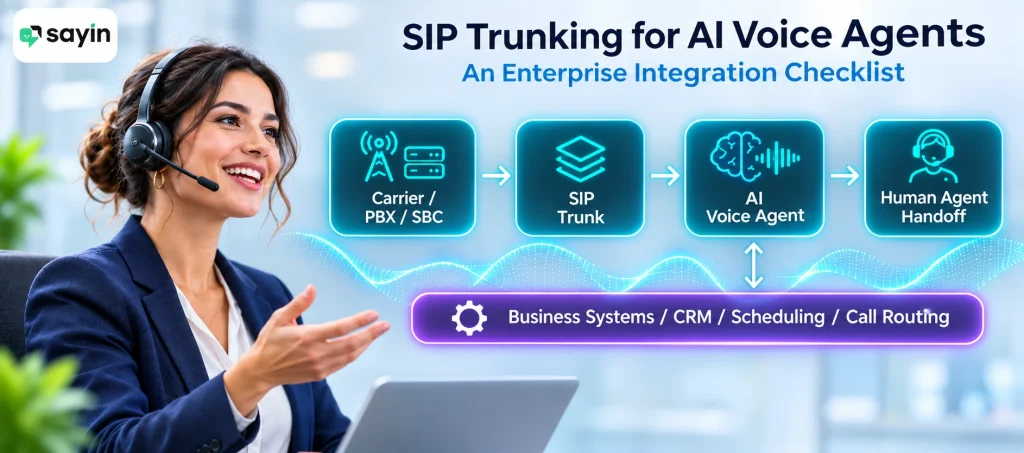
Your contact center already has phone numbers, carrier contracts, queues, and human-agent workflows. Introducing AI voice agents should not require redesigning all of them before you know which conversations AI can handle.
SIP trunking for AI voice agents is one possible way to connect compatible telephone infrastructure with an AI application. Yet a connected call is not a completed customer interaction. Teams must decide where AI enters the call flow, what happens when the AI cannot help, and how to verify the deployment before expanding it. This enterprise checklist explains the decisions to make—not vendor-specific SIP configuration steps.
What Does SIP Trunking Do in Voice AI Deployment?
Session Initiation Protocol (SIP) establishes, modifies, and ends communication sessions. A SIP trunk is a logical connection used to exchange telephone sessions between compatible systems or services. With the right configuration, it may route calls from a carrier, private branch exchange (PBX), or contact center platform toward an AI voice application.
SIP handles session signaling. Voice media commonly travels over RTP or, where configured, SRTP. The AI application separately recognizes speech, manages the conversation, and executes approved workflow actions.
These layers must not be confused. Successful SIP call setup does not prove two-way audio quality, fast AI responses, or task completion. A SIP extension used as a transfer destination also does not establish that a platform accepts arbitrary inbound SIP trunks.
Where Should AI Enter Your Existing Call Flow?
Consider a hypothetical 200-seat contact center. Its team wants AI to answer routine order-status inquiries while leaving billing disputes, complaints, and complex technical problems with human agents.
Three entry points are worth evaluating.
Selected inbound calls
The current phone system routes a defined category of eligible calls to an AI workflow. The team must establish how eligibility is identified and what happens when the caller is misrouted or changes topics.
Overflow or after-hours coverage
Approved calls reach AI when agents are busy or unavailable. Queue thresholds and office hours should not override exception rules: sensitive cases still need an appropriate human or fallback process.
AI intake before human handoff
AI gathers an order number and reason for calling, then transfers when caller requests a person. The business must test caller continuity and whether captured context reaches the employee through a supported mechanism.
For contact center, a limited order-status pilot is the defensible starting point. Disputes stay human-led. Failed lookups, unsupported requests, and explicit requests for a person trigger documented escalation behavior.
Which Integration Path Should You Investigate First?
SIP, telephony APIs, and managed integration describe different layers or responsibilities; they can be combined. SIP establishes and manages sessions, while provider APIs may control call events and routing. Managed integration concerns how supported components are configured, tested, and maintained—not a separate communications protocol.
Use your existing environment to choose the first technical conversation:
Five Requirements to Confirm Before Deployment
- Carrier and number compatibility: Identify number ownership, incoming call routing, any forwarding requirements, SBC dependencies, and responsibility for configuration changes. Do not assume a retained number means native BYOC is supported.
- Explicit AI eligibility rules: List the call categories AI may handle, excluding cases, and escalation triggers. For the order-status pilot, an unsuccessful lookup or a complaint must not silently become an unresolved AI-only interaction.
- Audio, security, and latency requirements: Confirm codec negotiation, media paths, network conditions, SIP authentication, and applicable encryption. TLS may protect SIP signaling and SRTP may protect media, but availability and configuration must be verified for the actual deployment. Also assess response latency across the complete conversation.
- Human transfer and context: Confirm whether the intended routing involves a SIP transfer mechanism, provider-controlled bridging, or another supported method. SIP REFER alone does not guarantee a successful warm transfer. Passing an order number or conversation summary to the human is a separate application or integration requirement. Test both the connection and the briefing. Also, compare warm and cold transfers.
- Capacity, fallback, and ownership: Define expected concurrency, what happens when AI or a carrier component is unavailable, who receives alerts, and where calls should go. A fallback that exists only in an architecture diagram is not an operational plan.
How Should a Production-readiness Pilot Be Tested?
A single successful demonstration call validates very little. The pre-deployment testing checklist should combine technical traces, representative conversations, and business outcomes.
For the example contact centers include wrong order numbers, unavailable backend records, a caller requesting a person, a busy transfer destination, and an AI service outage. Track call-setup success, media quality, conversational response, task completion, transfer success, and recovery success separately. One aggregate “successful calls” figure can conceal failures in another layer.
Review the pilot against its agreed acceptance criteria before routing additional categories or traffic to AI.
When Does a Managed Voice AI Approach Make Sense?
Connecting AI voice agents to existing telephony infrastructure involves more than choosing a connection method. Enterprises must align routing requirements, conversation workflows, and much more before deployment. A managed approach can help organizations coordinate these decisions without independently managing every component of the implementation.
Sayin provides managed AI voice agents designed to support business conversations, existing integration environments, and human handoffs. Rather than treating every call as an automation opportunity, businesses can identify suitable workflows, establish escalation rules, and evaluate the technical requirements of their existing calling setup.
For enterprises considering SIP trunking, the important first step is validating the proposed connection against their carrier, PBX, or contact center platform. The objective is to determine where Voice AI fits the existing operation, what to test before launch, and how to evaluate performance after deployment.
Find the Right Voice AI Integration Path with Sayin
Your existing calling infrastructure should guide how to introduce AI into the equation. Whether you’re evaluating call routing, AI-assisted intake, or human-agent handoffs, Sayin can help you discuss the operational requirements and available integration options for your environment.