
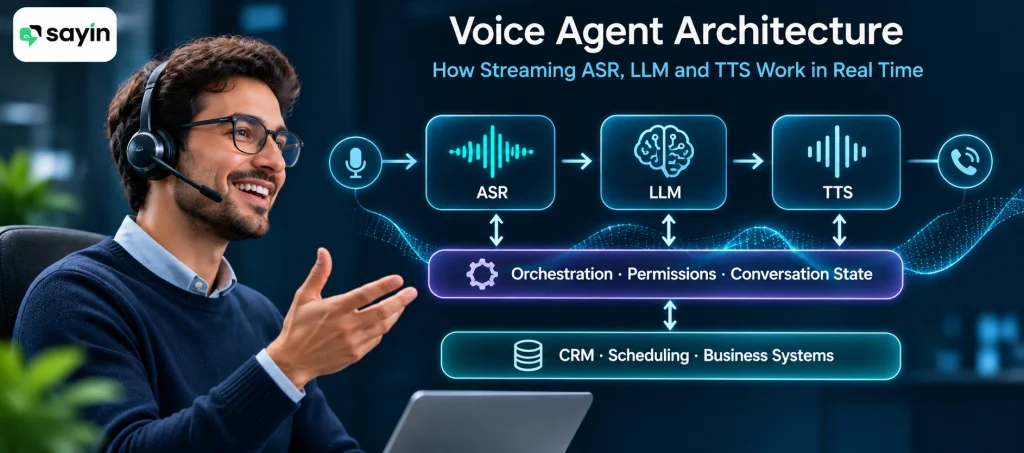
A voice agent can sound natural yet mishandle an interrupted request. The architecture decision is not simply which model produces the most convincing speech: it is how audio processing, conversation control, and business systems work together. A team choosing a system must distinguish an attractive processing design from a production implementation it can govern.
Voice agent architecture defines those boundaries. The guide compares streaming ASR–LLM–TTS, native speech-to-speech, and hybrid approaches, then provides a shortlist framework focused on architectural fit rather than duplicating a full voice-agent acceptance-testing plan.
What Is Voice Agent Architecture?
A production system typically connects three layers. Conversation processing interprets incoming audio and generates speech. Orchestration maintains conversational state, controls tools and permissions, and handles decisions. Operations and transport support telephony, transfers, monitoring, and recovery.
These layers interact, but selecting a speech model does not select the rest of the system. A native audio model can delegate to independently governed business workflows; a modular speech pipeline still needs explicit authorization and failure handling. Architectural labels describe useful design patterns, not guarantees about outcomes.
How Does a Streaming ASR–LLM–TTS Pipeline Work?
In a cascaded design, automatic speech recognition (ASR) converts audio into text, a large language model (LLM) interprets the request, and text-to-speech (TTS) produces the spoken reply. Streaming overlaps compatible stages rather than waiting for each complete output.
- ASR: Partial transcripts arrive while the caller is speaking. They may change as context develops, so early text can support provisional interpretation without becoming a final instruction. “Move my booking to Friday—actually, Monday” is not permission to commit Friday.
- LLM and orchestration: The model can plan an answer or propose a tool call while a separate control layer checks session state, required information, permissions, and confirmation. Preparing a response and committing an account change are different events.
- TTS: Audio can be synthesized as text becomes available. If the caller interrupts, the system may need to discard queued output and revise its answer. This does not by itself cancel a tool call.
Three boundaries matter: stopping playback, requesting cancellation of in-flight work, and reversing an already completed transaction. A cancellation request can arrive too late to prevent external action. The application may need to reconcile final state before saying what happened. Streaming therefore introduces coordination responsibilities alongside potential responsiveness benefits. Detailed latency measurement belongs in Sayin’s voice AI latency guide.
Cascaded vs Speech-to-Speech vs Hybrid Voice Architectures
These are practical comparison groups rather than a standardized, exhaustive taxonomy. Actual systems can combine elements across categories.
Cascaded ASR–LLM–TTS
Separate recognition, reasoning, and synthesis allow intermediate text to be inspected, transformed, or validated. Providers may also be replaced independently. The cost is additional interfaces to coordinate and troubleshoot. Cascaded approaches deserve early consideration when explicit transcript processing or component portability is mandatory, provided the implementation exposes those controls.
Native Speech-to-Speech
An integrated audio model can receive speech and return speech without exposing a separate text pipeline. It may retain cues such as hesitation and emphasis that transcription can discard. However, transcripts, tool calls, interruption support, observability, and policy enforcement depend on the interface and surrounding application. An integrated model is not automatically faster, safer, or less controllable than a cascade system.
Hybrid Voice Architectures
Hybrid is an umbrella term, not a single intermediate design. One system might interpret audio directly but use a separate speech generator, while another might use a full-duplex audio interface. Evaluate precisely which components share a model, which exchange structured outputs, and which remain independently governed. Otherwise, two products marketed as hybrids may have little operational similarity.
How Do Turn Detection, Tools, and Telephony Affect Architecture?
Turn detection identifies when an utterance is complete. Voice activity detection signals speech or silence, while endpointing and contextual turn detection help decide when to respond. Preemptive generation may start work before turn completion; that work can be discarded when the caller continues.
- Interruptions and tools expose different control boundaries. Stopping an outdated spoken response is a conversation-layer operation. An external API call may continue independently; even acknowledging cancellation does not establish that a completed action was undone. Applications need state-aware recovery rather than if barge-in reverses work.
- Telephony brings additional dependencies: call transport, SIP integration, media gateways, and transfer paths. A robust model does not prevent a dropped connection or a failed handoff. These are architectural interfaces that buyers should identify before selecting components.
How Should Enterprises Choose a Voice Agent Architecture?
When deploying real-time ASR, LLM, and TTS pipelines, telecom teams must evaluate SIP trunking for AI voice agents to route audio streams efficiently through existing SBCs. Consider an appointment assistant supporting callers who frequently pause, correct dates, and switch between self-service and a human representative. Architecture selection should proceed in five decisions.
- Identify the conversational constraint. Is the priority explicit text inspection, retaining vocal nuance, or continuous interaction while backend work runs? Write the requirement before comparing model types. Each answer points to different designs worth evaluating.
- Draw the required boundaries. Identify where transcripts must be available, where policy checks run, whether the current CRM workflow can remain separate, and who controls playback and handoffs. This prevents the phrase “end-to-end voice model” from obscuring application responsibilities.
- Shortlist by fit, not marketing label. If auditors need to examine intermediate text before a regulated action, start with cascaded candidates. If direct audio interpretation is central, include native or suitable hybrid candidates. If a text-agent backend already contains validated business logic, prioritize designs that can reuse it. These are initial preferences, not exclusions that apply universally.
- Distinguish dealbreakers from trade-offs. Missing mandatory authorization boundaries or an unusable required integration disqualifies implementation. Extra orchestration effort, different speech characteristics, or a more involved provider contract may be negotiable. A failure in one vendor product does not invalidate an entire architecture category.
- Request architecture-specific proof. Ask vendors to show the exposed stage boundaries, delegated tool-control interfaces, interruption-state behavior, portability constraints, and available traces. Then hand detailed scenario execution and go-live acceptance to the separate testing process described in Sayin’s telecom voice-agent testing guide. Operating ownership is a separate choice addressed in managed voice AI versus DIY.
Choosing Real Customer Conversations
Cascaded designs offer distinct speech stages; native systems integrate audio processing; hybrid arrangements vary by boundary and control model. The right voice agent architecture depends on conversational requirements, integration constraints, and the operational controls an enterprise must retain.
Sayin offers managed AI voice agents for business calling workflows. That positioning does not establish which underlying architecture Sayin uses. Experience a Sayin live demo to assess conversation handling and practical workflow fit.
Scale Voice Infrastructure with Confidence
Explore how Sayin’s managed voice agents handle real-time streaming, complex tool orchestration, and enterprise telephony integrations seamlessly.
