
A customer calls about a delayed order. The automated voice agent checks the account, apologizes, and offers a $200 refund. This conversation sounds helpful. But the company’s policy allows automated refunds only up to $50.
Here the problem is AI misunderstood the caller and made a commitment beyond its authority. For businesses deploying AI voice agents, this distinction matters. An agent may understand a request perfectly and still makes an unauthorized decision, disclose restricted information, or confirm an action that never happened.
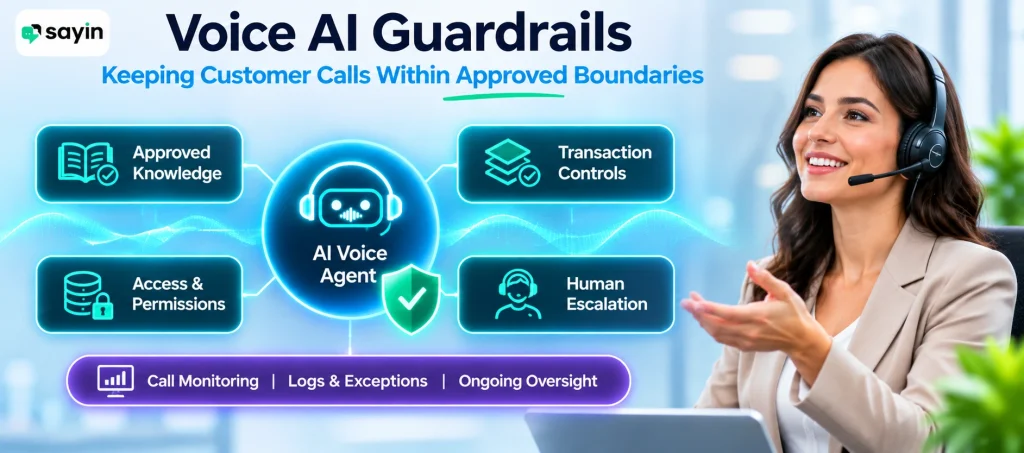
Voice AI guardrails help prevent these failures by defining what an agent is allowed to say, access, and do during customer conversations.
When properly implemented, they establish boundaries without preventing automation from handling approved tasks.
What Are Voice AI Guardrails?
Voice AI guardrails are rules, technical restrictions, and operational procedures that control how AI voice agents behave during live conversations. They determine which information an agent can use, what actions it may perform, when additional authorization is required, and when a request should be transferred to a human. An effective approach includes three distinct control layers:
For instance, telling an AI agent not to exceed a refund limit is a conversational instruction. Configuring the transaction system to reject an unauthorized refund is an independently enforced restriction. A business deploying voice AI should understand which controls rely on agent instructions, and which are enforced by the surrounding application or backend system.
Where AI Voice Agents Can Create Operational Risk?
The greatest risks often emerge from ordinary customer requests.
- Unverified commitments: Caller asks whether a replacement product will arrive tomorrow. Without reliable delivery information, an AI agent could make a promise the business cannot fulfill.
- Unauthorized transactions: Agent connected to a CRM or billing platform may receive a request to modify an account, issue a refund, or apply an exception beyond its approved permissions.
- Sensitive information disclosure: Caller requests another person’s account details or fails the required identity checks. The agent must not treat conversational confidence as proof of authorization.
- Unconfirmed system actions: Scheduling platform times out after an appointment-change request. The AI cannot assume the booking succeeded simply because it submitted the request.
- Unresolved exceptions. A customer disputes a policy, reports an unusual issue, or repeatedly asks for assistance outside the agent’s scope.
The common failure is not necessarily poor speech recognition. It is the absence of a reliable boundary between understanding a request and acting on it.
Six Voice AI Guardrails Businesses Should Evaluate
The appropriate safeguards depend on the workflow, customer information involved, connected systems, and potential consequences of incorrect action. The following six areas provide a practical starting point for evaluating enterprise AI voice agents.
1. Approved Knowledge and Answer Restrictions
An AI voice agent should use authorized information when discussing prices, policies, eligibility, account processes, or service commitments. If the approved knowledge source cannot answer a question, the agent needs a defined fallback rather than an improvised response. For example, if two policy documents contain conflicting return periods, the agent should not independently choose whichever answer sounds more plausible.
2. Identity Verification and Data Protection
Customer-specific conversations may involve personal, financial, or other sensitive information. An AI agent should distinguish between general inquiries and requests requiring identity verification or additional authorization. Failed verification should restrict access to protected information, even when the caller sounds convincing.
3. Transaction Permissions and Approval Limits
Some AI voice agents do more than provide answers. They interact with business systems to update records, schedule appointments, or initiate transactions. These actions require permissions appropriate to their business impact.
For instance, an agent might be authorized to update contact details but prohibited from approving financial exceptions. The relevant application or backend system should enforce critical restrictions independently of the model’s conversational instructions.
4. Conversation Scope and Recovery Rules
Not every customer request belongs within an automated workflow. An agent may encounter conflicting information, unclear instructions, unsupported requests, or circumstances requiring human judgment. Instead of generating increasingly speculative answers, it should follow an approved recovery process.
5. Human Escalation and Transfer Conditions
Human escalation should be a planned part of the customer journey, not an improvised response after the AI fails. Organizations should identify situations that require intervention, such as disputed transactions, sensitive complaints, failed verification, or requests exceeding the agent’s authority.
A successful handoff should also preserve the permitted context needed to continue the interaction, subject to verification and information-sharing rules.
6. Call Monitoring and Exception Review
A voice agent’s behavior needs oversight after deployment. Changes in business policies, knowledge sources, customer behavior, or connected systems can introduce new failure conditions.
Call monitoring should help operational teams identify recurring exceptions and determine whether safeguards continue to operate as intended. Businesses should apply appropriate privacy, retention, and access restrictions to any records collected.
What Happens When a Voice AI Guardrail Is Triggered?
The effectiveness of a safeguard depends on what the system does when a boundary is reached. Consider these customer service scenarios:
These are recommended operational patterns, not claims that every deployment follows identical rules. The underlying principle is consistent: an AI agent should not compensate for missing authority or unreliable information by producing a confident answer.
Businesses also need to decide which interactions should remain automated in the first place. AI voice agents for customer service lets organizations divide responsibilities between AI agents and human teams.
How to Verify Voice AI Guardrails Before and After Launch?
Defining a restriction does not establish that it works. Verification should examine whether the agent and its connected systems behave correctly when customers attempt actions outside the approved scope.
Check prohibited actions, not only successful conversations
A routine appointment booking may demonstrate that an agent can complete a workflow. It does not prove the agent will reject an unauthorized account change. Testing should include restricted requests, failed verification, unavailable information, and unexpected system responses.
Confirm system outcomes independently
A spoken confirmation is not proof that a transaction succeeded. When an AI agent updates a booking, changes a record, or initiates a customer request, the relevant system should provide evidence of the actual result. An unavailable response also should not automatically trigger a repeated transaction that could create duplicate effects.
Review exceptions as operations change
After launch, teams should examine blocked actions, unsuccessful transfers, failed integrations, and recurring requests outside the agent’s approved responsibilities. Configuration changes and new integrations may require safeguards to be reviewed and tested again.
AI voice agent testing for telecom contact centers set acceptance evidence and testing expectations in greater detail. The NIST Generative AI Profile also provides a broader risk-management reference covering governance, evaluation, and oversight of generative AI systems.
Who Is Responsible for Maintaining Voice AI Guardrails?
Voice AI governance requires shared ownership. Operations leaders should define the agent’s business responsibilities, acceptable outcomes, and escalation requirements. IT and security teams should establish appropriate access systems, authorization controls, and technical restrictions. Compliance stakeholders should assess requirements relevant to the business, industry, and deployment. The team managing the AI voice agent should maintain its configuration, review exceptions, and coordinate approved changes.
For managed deployments, these responsibilities should be clearly divided between the organization and its provider. Sayin’s managed AI voice agent services provide a model for organizations seeking support with agent configuration and ongoing optimization. However, a managed service does not remove the customer’s responsibility for defining its policies or meeting its applicable obligations.
What Should You Ask a Voice AI Vendor About?
Before selecting a platform, business leaders should understand how the system responds when a customer request exceeds its authority. Ask prospective vendors:
- Knowledge restrictions: Can agents supply pre-agreed information sources, and what happens when an answer is unavailable?
- Action permissions: Are transaction limits enforced independently of the AI’s instructions?
- Customer data: How are identity verification and restricted information handled?
- Escalation: Which situations trigger human intervention, and what happens if a transfer fails?
- Operational visibility: Can authorized teams review call outcomes and investigate exceptions?
- Security evidence: What documentation and security commitments apply to the proposed deployment?
- Ongoing ownership: Who maintains the safeguards when business policies or integrations change?
Request evidence relevant to your intended workflow rather than relying only on a demonstration of conversational quality. Voice AI agents support security-related controls and documentation.
Responsible Voice AI Requires Clear Business Boundaries
The purpose of voice AI guardrails is not to limit automation unnecessarily. It is to make automation accountable to the business processes it supports. An agent should have enough authority to complete approved tasks, clear restrictions on information and system access, and a defined route to human assistance when appropriate.
Sayin supports knowledge restrictions, transaction permission controls, identity verification, sensitive-data safeguards, configurable escalation, and call-level monitoring. The application of these capabilities depends on the organization’s requirements and implementation.
See How Sayin Handles Controlled Customer Conversations
Explore how Sayin’s AI voice agents can support your workflows while respecting configured information boundaries, action permissions, and escalation rules.